
Building a niche site from zero is harder than most tutorials suggest, and finding a niche site SEO framework that is honest about the process is even harder. This article documents what I have learned about niche site SEO across two real projects – what I decided, what I got wrong, and what I am still working out. If you are looking for an SEO framework for niche sites built on real decisions rather than theory, this is what that looks like in practice.
Two projects I am currently documenting are PadelGameplan.com, an informational content site focused on the sport of padel, and OudSelect.com, a niche content and affiliate site covering oud fragrances. Both are ongoing experiments. Neither is a success story I am ready to claim. But both have produced learning that reading about SEO alone could not have given me.
What This Framework Is, in Brief
The framework I use for niche sites focuses on three things: choosing a small topic area with real search demand, building a logical content structure before publishing, and then filling it in consistently over time. Intentionally simple by design, this approach does not involve complex link building strategies, aggressive interlinking formulas, or advanced technical audits at the early stage. Someone building alone, learning as they go, and trying to make decisions that make sense rather than chasing shortcuts will find this most relevant.
This approach may not apply to every niche or competitive landscape. It is what I have been working with, and I am still testing it.
Why I Chose These Niches
The decision to build around padel came before any keyword research. English-language content around padel – particularly instructional, tactical, and beginner-focused content – was noticeably thin compared to what existed in Spanish or other European languages, and that gap felt like a real opportunity worth exploring. That gap felt like a real opportunity, not a manufactured one.
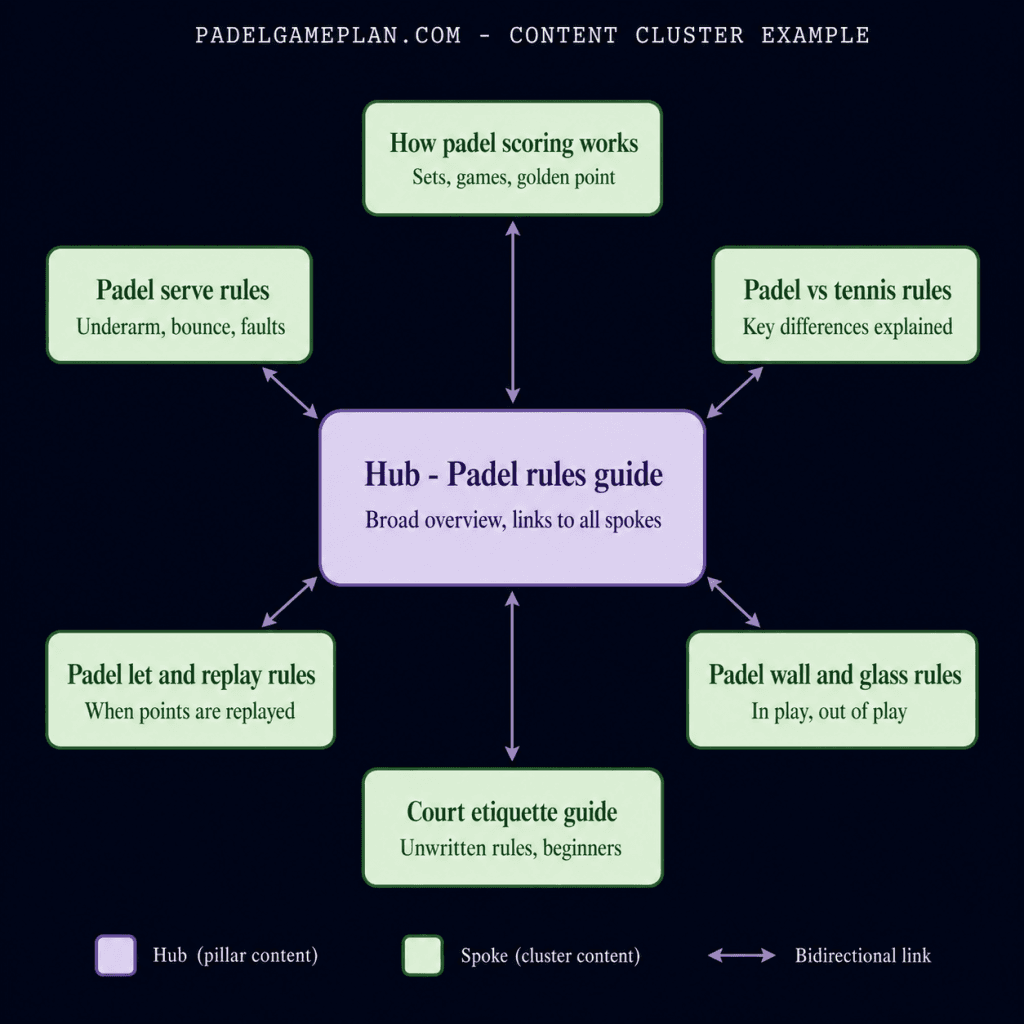
With PadelGameplan.com, the intent was always informational. The questions people search around padel tend to be practical: how to serve, what racket to buy, how the scoring works, what rules differ from tennis. These are clear topics with obvious structure.
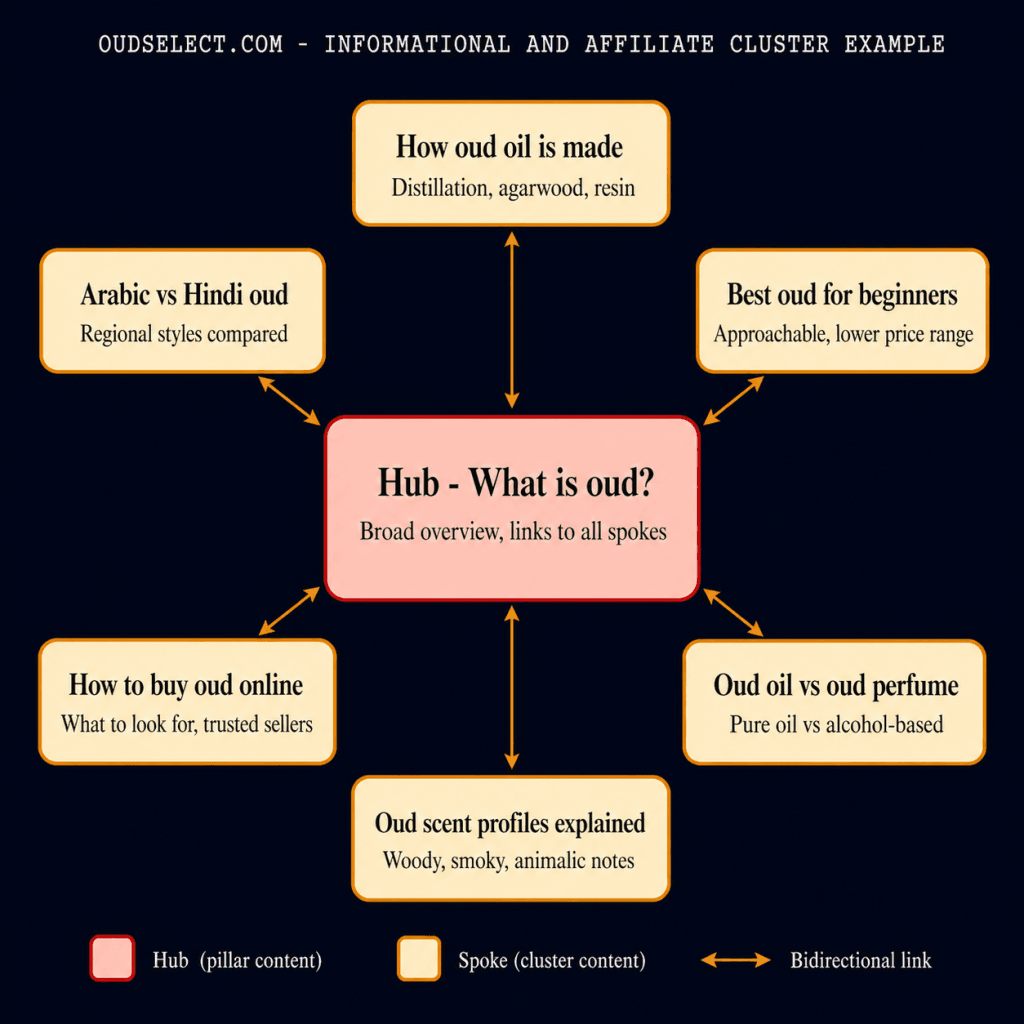
OudSelect was a different starting point. While the broader fragrance space online is crowded, the oud subcategory – particularly niche and artisanal oud – had noticeably fewer dedicated English-language resources, and that gap made it worth exploring. OudSelect.com was an attempt to build something useful in that gap, combining content and affiliate-style coverage of products.
The risks I did not fully understand at the start:
- Padel is a growing sport, but growth does not automatically translate to search volume. Some terms I expected to perform had almost no monthly searches.
- The oud fragrance space has a passionate but relatively small audience online. Affiliate conversion in this category is harder to predict than in high-volume product categories.
- I had no existing domain authority on either site. Starting from zero means every piece of content is competing against established sites from day one.
I went into both projects with genuine interest and a rough sense of opportunity. I did not go in with certainty.
The SEO Framework I Actually Use
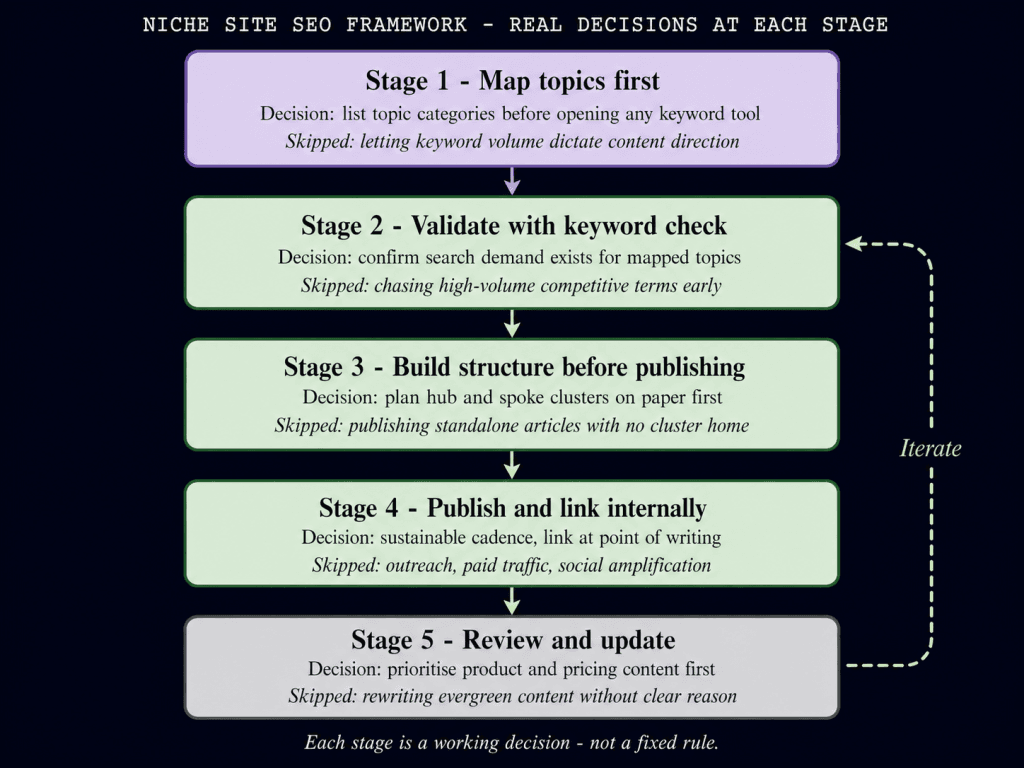
This is not a finished methodology. It is how I approach niche site projects, in stages, with adjustments made along the way.
Topic Selection Before Keyword Tools
Before opening any keyword research tool, I try to answer a simple question: what are the most common things someone new to this topic would need to know, and what are the questions someone more experienced would search for?
For padel, I mapped out categories: rules, equipment, technique, strategy, court etiquette, comparison with tennis. For oud, the categories were: what is oud, types of oud, buying guides, brand comparisons, beginner recommendations.
Only after building this rough map did I go into keyword tools to check whether the topics I had identified had any search demand. This sequence mattered. Starting with a topic map kept the content structure coherent. Starting with keyword tools alone would have led me to chase isolated terms without a coherent structure underneath.
Content Structure Before Publishing Volume
On both sites, I try to establish a basic hub-and-spoke structure before publishing large volumes of content. A hub page covers a broad topic – for example, padel rules or buying oud online – and supporting pages go deeper on specific sub-questions.
I have not executed this perfectly. Some sections of both sites have gaps where I planned spoke pages but have not yet published them. But the structural thinking comes first, and I believe this is the right sequence even when the execution is incomplete.
A Publishing Cadence I Can Actually Sustain
I am building these sites alongside other commitments. Any publishing schedule that required daily or even multiple weekly posts was not realistic. I settled on a cadence I could sustain – a few articles per week when possible, fewer when not.
What I try to avoid is publishing in bursts followed by long silences. I am not certain how much publishing consistency matters as a direct ranking factor, but it matters for building a complete site, which does matter.
Internal Linking as I Publish
Rather than doing a formal internal linking audit, I add contextual internal links at the point of writing. When a new article references a topic that an existing article covers, I link to it.
This is probably the messiest part of the framework. I have not been as systematic as I should be. There are articles on both sites that are more isolated than they should be.
What I Intentionally Do Not Do Early
- No aggressive link building outreach in the first months
- No paid traffic to test content
- No social media push to artificially inflate traffic signals
- No complex technical SEO work beyond basic on-page elements
This is partly a resource decision and partly a deliberate choice to see what organic signals alone produce before layering in more variables.
What Works (So Far)
A word of caution before this section. This section reports no metrics and presents no outcomes that cannot be verified or that might change. What structural and content decisions appear to produce positive signals is what this section covers – based on what I observe in Search Console over time.
Topical grouping seems to matter. When I publish several articles around the same narrow topic in a short period – for example, a cluster of padel serving technique articles – the hub page for that cluster appears to gain more visibility than isolated articles do when published without related supporting content.
Clear, specific titles perform better than vague ones. Articles with titles that directly match a question appear to index and gain visibility more readily than titles written to sound comprehensive. This is a small observation, not a conclusion.
Focusing on the actual question a reader types, rather than writing to be exhaustive, appears to help. Some of my earlier articles tried to cover everything about a topic in one piece. Shorter, more focused pieces that answer one specific question directly seem to perform better in the cases I have compared.
What Has Not Worked or Was a Mistake
| Mistake | What I would do instead |
|---|---|
| Targeting competitive terms too early | Start with low-competition, long-tail questions |
| Over-optimising titles with keywords | Write the title for the reader first |
| Publishing articles with no internal links | Assign every article to a cluster before writing |
| Assuming less competitive means faster results | Set realistic timeline expectations from the start |
| Skipping meta descriptions | Write meta descriptions as part of the publishing checklist |
Targeting the wrong terms early
Targeting terms that were too competitive too early was the most costly mistake in terms of time. In the early months of PadelGameplan.com, I wrote articles targeting terms like “padel racket” and “best padel shoes” – terms where established retailers and affiliate sites with significant authority dominated the results. These pages have had very limited visibility. The mistake was not recognising that informational intent and commercial intent terms often face very different competitive landscapes.
Over-optimising and poor structure decisions
Over-optimising titles was a phase that made the content feel less natural without any visible benefit. Publishing articles without a clear home in the site structure left some early OudSelect pages isolated and harder for search engines to contextualise.
Misjudging the timeline
Expecting a less competitive niche to produce faster results was probably the biggest mistake in terms of mindset. Both niches are less competitive than mainstream categories, but less competitive does not mean uncompetitive, and it does not mean fast.
How the Two Sites Differ in SEO Approach
| Factor | PadelGameplan.com | OudSelect.com |
|---|---|---|
| Primary intent | Informational | Informational and affiliate |
| Content format | Instructional, step-by-step | Descriptive, comparative |
| Update frequency | Low – rules and technique are stable | High – products and pricing change |
| Internal linking | Natural hierarchy, easy to connect | Narrow category, requires more effort |
| Monetisation path | Longer term | Affiliate-driven |
| Competitive landscape | Growing but low English-language competition | Small audience, few dedicated English sources |
Informational vs Affiliate Intent
Padel Gameplan is almost entirely informational. Readers are looking to learn something. The content does not need to push anyone toward a purchase. This simplifies some decisions – there is no tension between helpful content and promotional intent – but it also means monetisation is a longer-term consideration.
OudSelect sits between informational and commercial. Some content is purely educational – what is oud, how oud is made – but other content moves closer to buying guidance. This means some pages need to do two things at once: inform and gently direct. Getting that balance right is something I am still working on.
Content Depth
Padel articles tend to be more structured and instructional. A piece on padel serving technique benefits from step-by-step structure and clear headers. Oud content is often more atmospheric – describing scent profiles, comparing styles, explaining regional differences. The depth and format differ significantly between the two.
Update Strategy
Padel content around rules, technique, and strategy is relatively stable. Equipment content needs more regular updating as products change. On OudSelect, product availability and pricing change more frequently, which means that content requires more active maintenance. I have not been as on top of this as I should be.
Internal Linking Differences
Padel Gameplan has more natural internal linking opportunities because the topic categories connect clearly. A beginner guide links naturally to a rules article, which links to a scoring article. The hierarchy is logical.
On OudSelect, the category structure is narrower, which means internal linking requires more deliberate effort to avoid sending every article to the same small set of hub pages.
What I Would Do Differently If Starting Again
Starting with a smaller initial content scope. On both sites, I spread content too wide too early. If starting again, I would pick two or three topic clusters and publish those comprehensively before expanding into adjacent areas. Depth before breadth.
Establishing the site structure as a written document before publishing anything. I had a rough mental map but did not formalise it. A written structure, even a simple one, would have made content decisions faster and internal linking more deliberate.
Paying more attention to search intent from the start. Some of my earlier articles addressed topics without clearly identifying what kind of content a searcher actually wanted – a list, a step-by-step guide, a comparison, a definition. Getting this right earlier would have saved some rewriting.
Being more patient with the domain age phase. Every new domain goes through a period where search engines limit visibility regardless of content quality. I spent too much energy second-guessing content decisions during this phase when patience was the more appropriate response.
Who This Framework Is Actually For
| This framework suits | This framework does not suit |
|---|---|
| Solo site builders learning through practice | Agencies managing sites at scale |
| People with genuine interest in their niche | Builders needing fast commercial results |
| Those testing SEO without a large budget | Sites in highly competitive categories |
| Anyone building for the long term | Those relying on link building or paid traffic |
This approach is most likely to be useful for individuals building niche sites and learning SEO through practice, solo site builders who do not have a team or significant budget, and people who are genuinely interested in their niche and can sustain writing about it over time.
I am a practitioner still in the middle of the learning curve. The framework reflects that position. This framework suits someone with limited time, limited budget, and genuine interest in their topic who wants to make realistic progress. Whether it produces significant results at scale is something I do not yet know.
Conclusion
SEO is not something I have figured out. These projects are ongoing experiments, and they have produced learning that reading alone could not have given me.
What building Padel Gameplan and OudSelect from zero has reinforced is that the process matters more than the plan. Decisions made in practice – which topics to prioritise, how to structure a cluster, when to update versus when to publish new content – are not learnable from a course or a guide. They become clearer through repeated attempts and honest observation of what happens.
Documenting this honestly, including the mistakes and the unknowns, matters more to me than presenting a polished case study. The sites are real. The framework is real. The results are still unfolding.
FAQ
How long does it take to see results from a new niche site?
This varies significantly and depends on domain age, niche competition, content quality, and many other factors. Based on widely shared practitioner experience, new domains often see limited organic visibility for the first six to twelve months. No timeline can be guaranteed.
Do I need to build backlinks to rank a niche site?
Backlinks remain an important signal in Google’s ranking systems. However, many niche sites in lower-competition categories do gain visibility through content quality and topical depth before actively building links. The appropriate strategy depends on the niche and the competition present.
What keyword research tools are useful for niche site builders?
Commonly used tools include Google Search Console (free), Ahrefs, Semrush, and Ubersuggest. For those starting out, Google Search Console combined with Google’s autocomplete and People Also Ask features provides a useful starting point without cost.
Is padel a viable niche for an SEO site in English?
Padel is a growing sport with increasing search interest in English-speaking markets. However, search volumes for many padel-related terms remain relatively low compared to mainstream sports. It may suit a practitioner willing to build over a longer horizon rather than someone needing fast volume.
What makes oud a challenging niche for affiliate content?
The oud fragrance market is enthusiast-driven with a smaller audience than mainstream fragrance categories. Product availability can be inconsistent, prices are often high, and affiliate programs in this space are less common than in general fragrance retail. Conversion rates may be harder to predict.
Should niche sites cover broad or narrow topics first?
Based on common practitioner experience, starting with a narrower cluster of closely related topics and building depth before expanding tends to produce more coherent site structure and stronger topical signals. This is a general observation, not a universal rule.
How often should content be updated on a niche site? Content that references specific products, pricing, or time-sensitive information benefits from regular review. Evergreen instructional content may require less frequent updating. The right cadence depends on how quickly information in a given topic area changes.
Can a solo builder realistically compete in niche SEO?
Many successful niche sites have been built by individuals. The realistic advantage a solo builder has is genuine interest and niche depth. The disadvantage is capacity – producing and maintaining content takes time. Success is possible but requires realistic expectations around pace.
What is the difference between informational and affiliate niche sites for SEO purposes?
Informational sites target primarily educational queries and typically monetise through advertising, sponsorship, or brand building. Affiliate sites target commercial and comparison queries and earn through referral commissions. Each faces different competitive dynamics and requires a different approach to content framing.
Is this framework proven to work?
No. This framework is based on what one practitioner applies across ongoing projects during an active learning process. It reflects current thinking and real decisions, not a tested and validated methodology. Results will vary based on niche, execution, consistency, and factors outside any framework.
Sources
This article was published by Victor Detaro. It draws on practitioner experience and publicly available documentation. Core reference points include Google’s Search Essentials, which outlines how Google evaluates content quality and site structure, and Google’s Search Quality Evaluator Guidelines, which cover E-E-A-T principles in detail. The two sites referenced throughout – PadelGameplan.com and OudSelect.com – are ongoing projects and are not presented as finished case studies or proven results. General keyword research and niche site building principles referenced in this article are drawn from practitioner resources including the Ahrefs Blog and the Semrush Blog.